
Wholesale electricity markets and power systems modelling
We develop, maintain and run the following models/tools, covering the wholesale markets and the topology of the power transmission system, possibly with its interfaces with the distribution system. Time-resolution wise, we study dynamics occurring from real time to hours, days, weeks. As far as the time horizon is concerned, this may range from real-time to years ahead, depending on the research question.
We develop, maintain and run electricity markets and transmission/distribution system models/tools, including those based on PLEXOS, PyPSA, METIS, MATPOWER. More in detail, we perform:
- Electricity markets modelling to compare regional and nodal marginal pricing schemes.
- Market analyses for resources adequacy studies.
- Market analyses for bidding zones review.
We develop, maintain and run the electricity transmission/distribution system models/tools, including those based on PLEXOS, PyPSA, METIS, MATPOWER, RSCAD. More in detail, we perform:
- Electricity grids and topological modelling for contingency analyses
- Electricity transmission grids modelling
- Interlinked electricity transmission-distribution grids modelling
- Real-time dynamic simulation of power systems
- Hardware-in-the-loop testing
Selected publications featuring/based on our models/tools:

2025 - Locational Price Signals in Europe
In this work, we assess three different regulatory scenarios, which correspond to locational price signals at different spatial resolutions: A Status Quo scenario, representing the current bidding zone configurations; a Multi Split scenario, which assumes that ambitious bidding zone splits lead to 101 zones; as well as a Locational scenario with locational marginal pricing and locational investment signals. Both zonal scenarios (Status Quo and Multi Split) are further assessed in combination with locational investment signals of a high granularity.
We identified significant system security concerns, i.e. substantial curtailment of load, associated with the Status Quo, as well as the Multi Split scenario – yet at a lower magnitude in the latter case. These concerns can be traced to an inefficient operation of flexibility – such as storage and demand response – due to insufficient information on existing bottlenecks being present in the market-clearing process. Any system cleared with locational marginal pricing, on the other hand, always led to perfect reliability – even when applied to the investment outcomes of the Status Quo and Multi Split scenarios.
Our results further suggest substantial cost savings in the context of the Locational and the Multi Split scenarios. By 2040, the Locational scenario could reduce the total system cost by 23 – 59 Bn. EUR annually. These savings are in the order of magnitude of those associated with the integration of European electricity markets. They are a result of lower firm capacity requirements and a higher utilization of low-carbon energy sources. In addition, consumers in 62-90% of the geographic cells underpinning the model benefit from more granular pricing in our case study, – depending on the scenario. Increases beyond 5 EUR/MWh occurred only within up to 1.2% of all cells.
Due to the reliability benefits and the substantial increase in economic efficiency suggested by our results, we recommend to implement locational investment signals in all relevant investment mechanisms and introduce locational marginal pricing as an element of the European target model.
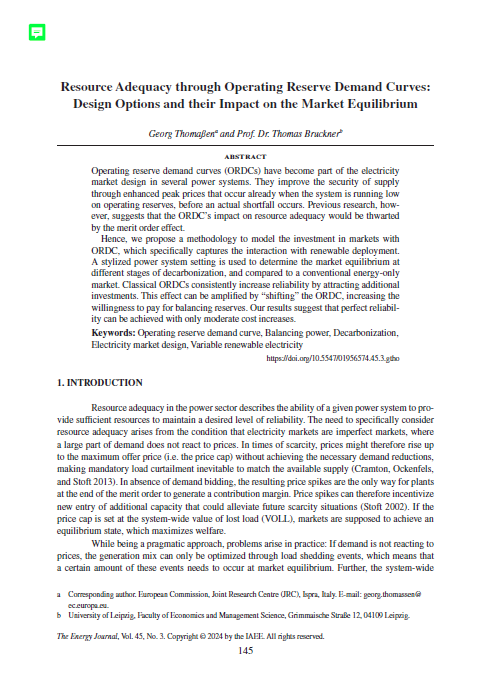
2024 - Resource Adequacy through Operating Reserve Demand Curves: Design Options and their Impact on the Market Equilibrium
Operating reserve demand curves (ORDCs) have become part of the electricity market design in several power systems. They improve the security of supply through enhanced peak prices that occur already when the system is running low on operating reserves, before an actual shortfall occurs. Previous research, however, suggests that the ORDC’s impact on resource adequacy would be thwarted by the merit order effect. Hence, we propose a methodology to model the investment in markets with ORDC, which specifically captures the interaction with renewable deployment. A stylized power system setting is used to determine the market equilibrium at different stages of decarbonization, and compared to a conventional energy-only market. Classical ORDCs consistently increase reliability by attracting additional investments. This effect can be amplified by “shifting” the ORDC, increasing the willingness to pay for balancing reserves. Our results suggest that perfect reliability can be achieved with only moderate cost increases.
2022 - An Efficient Framework to Estimate the State of Charge Profiles of Hydro Units for Large-Scale Zonal and Nodal Pricing Models
The power system is undergoing significant changes so as to accommodate an increasing amount of renewably generated electricity. In order to facilitate these changes, a shift from the currently employed zonal pricing to nodal pricing is a topic that is receiving increasing interest. To explore alternative pricing mechanisms for the European electricity market, one needs to solve large-scale nodal optimization problems. These are computationally intensive to solve, and a parallelization or sequencing of the models can become necessary. The seasonality of hydro inflows and the issue of myopic foresight that does not display the value in storing water today and utilizing it in the future is a known problem in power system modeling. This work proposes a heuristic step-wise methodology to obtain state of charge profiles for hydro storage units for large-scale nodal and zonal models. Profiles obtained from solving an aggregated model serve as guidance for a nodal model with high spatial and temporal resolution that is solved in sequences. The sequenced problem is guided through soft constraints that are enforced with different sets of penalty factors. The proposed methodology allows for adjustments to congestions on short timescales and proves to perform well in comparison to other approaches to this issue suggested in the literature. Following the input profile closely on a long timescale renders good results for the nodal model.
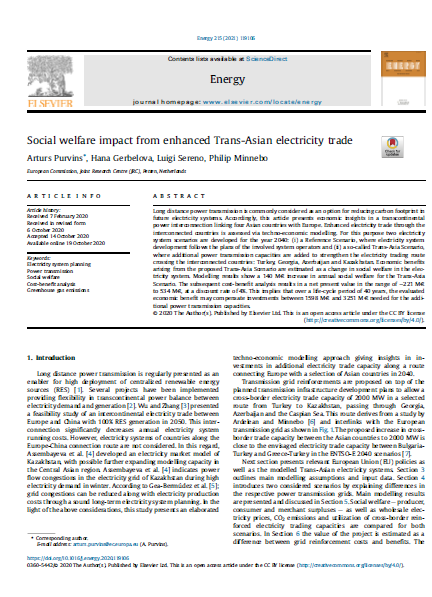
2021 - Social welfare impact from enhanced Trans-Asian electricity trade
This article presents economic insights in a transcontinental power interconnection linking four Asian countries with Europe. Enhanced electricity trade through the interconnected countries is assessed via techno-economic modelling. Economic benefits arising from the proposed Trans-Asia Scenario are estimated as a change in social welfare in the electricity system. Modelling results show a 140 MV increase in annual social welfare for the Trans-Asia Scenario. The subsequent cost-benefit analysis results in a net present value in the range of 221 M€ to 534 M€, at a discount rate of 4%. This implies that over a life-cycle period of 40 years, the evaluated economic benefit may compensate investments between 1598 MV and 3251 MV needed for the additional power transmission capacities
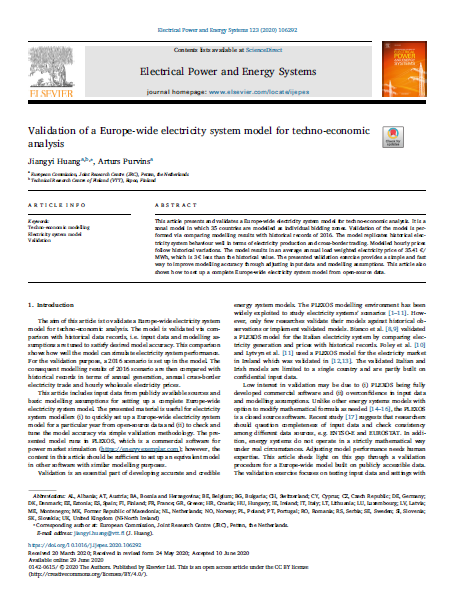
2020 - Validation of a Europe-wide electricity system model for techno-economic analysis
This article presents and validates a Europe-wide electricity system model for techno-economic analysis. It is a zonal model in which 35 countries are modelled as individual bidding zones. Validation of the model is performed via comparing modelling results with historical records of 2016. The model replicates historical electricity system behaviour well in terms of electricity production and cross-border trading. Modelled hourly prices follow historical variations. The model results in an average annual load weighted electricity price of 35.41 €/MWh, which is 3 € less than the historical value. The presented validation exercise provides a simple and fast way to improve modelling accuracy through adjusting input data and modelling assumptions. This article also shows how to set up a complete Europe-wide electricity system model from open-source data.
Retail electricity markets and distribution systems modelling
We develop, maintain and run the following models/tools, covering the retail/local markets and the topology of the power distribution system. Time-resolution wise, we study dynamics occurring from real time to hours, days, weeks. As far as the time horizon is concerned, this may range from real-time to years ahead, depending on the research question.
We develop, maintain and run the electricity distribution-local system models/tools, including those based on DINEMO, ResLoadSIM, NEPLAN, MATPOWER. More in detail we perform:
- Retail electricity markets and distribution-local systems modelling
We develop, maintain and run the electricity distribution-local system models/tools, including those based on DINEMO, NEPLAN, MATPOWER. More in detail we perform:
- Electricity distribution-local systems modelling
- Simulation of energy communities and final users
- Load modelling and forecasting for energy communities
- Load management under electricity crisis scenarios
- Real-time dynamic simulation of distribution systems
- Hardware-in-the-loop testing of distribution systems
Selected publications based on our models/tools:
2022 - Scenario-Based Modelling of Residential Sector Consumption: A Case Study in Latvia
Promoting the development of energy communities is one of the planned development areas mentioned in the Latvian National Energy and Climate Plan (NECP). Even though energy communities do not yet exist in Latvia, they could improve the quality of the environment and stimulate the local economy. In any case, it is expected that the structure of household energy consumption in Latvia will change as households start to adopt new technologies such as electric cars and heat pumps, as well as participate in energy production and demand response. Often the starting point for the development of an energy community is the geographic location of consumers. Therefore, for this study, a microdistrict was chosen in one of the most developed suburbs of Riga in Latvia, in which 76 households are located. The study identified five milestones on the path from mere neighborhood to the energy community. The resLoadSIM Residential Load Simulation tool was chosen to simulate realistic energy consumption with a 1-minute time resolution, as well as to model the future solar energy consumption and generation in the community on its way to becoming an energy community and meeting these goals. The network constraints associated with the transformer and lines are taken into account and it is assumed that the district will not invest in the development and expansion of the network. Based on the results of the modelling, an analysis was made of the impact of the development of the energy community in Latvia and how each stage of development will affect energy consumption, the amount of renewable energy, the energy sent to the grid, the power consumed directly, and the share of solar energy in energy consumption.
2020 - Distribution Network Models platform guideline
The Distribution Network Model (DiNeMo) is the collaborative platform where it is possible to model the electricity distribution grids of your community, city or region. This document provide a helpful guideline to the user.
2019 - Distribution Network Model Platform: A First Case Study
Decarbonisation policies have recently seen an uncontrolled increase in local electricity production from renewable energy sources (RES) at distribution level. As a consequence, bidirectional power flows might cause high voltage/ medium voltage (HV/MV) transformers to overload. Additionally, not-well-planned installation of electric vehicle (EV) charging stations could provoke voltage deviations and cables overloading during peak times. To ensure secure and reliable distribution network operations, technology integration requires careful analysis which is based on realistic distribution grid models (DGM). Currently, however, only not geo-referenced synthetic grids are available inliterature. This fact unfortunately represents a big limitation. In order to overcome this knowledge gap, we developed a distribution network model (DiNeMo) web-platform aiming at reproducing the DGM of a given area of interest. DiNeMo is based on metrics and indicators collected from 99 unbundled distribution system operators (DSOs) in Europe. In this work we firstly perform a validation exercise on two DGMs of the city of Varaždin in Croatia. To this aim, a set of indicators from the DGMs and from the real networks are compared. The DGMs are later used for a power flow analysis which focuses on voltage fluctuations, line losses, and lines loading considering different levels of EV charging stations penetration.
Integrated energy and socio-economic sectors modelling
We develop, maintain and run the following models/tools.
We develop, maintain and run gas & power systems models/tools, including those based on PLEXOS, PyPSA, METIS, MATPOWER.
We develop, maintain and run electricity & mobility sectors models/tools, including those based on MATPOWER, RSCAD. More in detail, we perform:
- tests and simulations of the interaction of the EV charging systems and the power grid.
Selected publications based on our models/tools:

2025 - Critical Gas-Fired Power Plants in Integrated Natural Gas and Electricity Systems
The interdependence between gas and electricity plays an important role in ensuring energy security in many regions in the world. In the European Union, there are regulatory frameworks that recognize this interdependency and the concept of critical gas-fired power plants (GFPPs) is introduced. Specifically, the Regulation (EU) No 2017/1938 on security of gas supply states that critical GFPPs may be given priority over certain categories of gas customers during gas supply crises when curtailment of gas is unavoidable. However, despite the significance of this issue, the Regulation does not set up clear rules about the designation of critical GFPPs. Within this context, we propose an optimisation problem for finding critical GFPPs in interconnected gas and electricity systems. The optimisation problem accounts for the gas and power system flow representation as well as links between both systems. We then analyse the main drivers for the identification of critical GFPPs such as the electricity network topology, the impact of the natural gas network, and the effect of fuel switching capabilities in GFPPs. In addition, the proposed model allows for a ranking of critical GFPPs provided that they should be prioritised over special categories of gas customers such as protected customers. The proposed methodology is applied to the IEEE Three-Area Reliability Test System (RTS).
2022 - Modelling the 2020 Greek electricity system using Plexos
This report presents publicly-available data to build up an electricity system model for Greece in 2020 including transmission, demand and generation data. The electricity network grid model accounts for the 400-kV transmission lines only. In addition, the impact of the COVID-19 outbreak on the Greek electricity demand compared to previous years is briefly analysed. Technical characteristics of fossil-fuel power plants and renewable generating units are subsequently described. Renewable generating units including wind and photovoltaic generation are aggregated at NUTS2 level with the latest available data. Cross-border flows and capacities with neighbouring countries are provided and discussed. Finally, Annex 1 contains the heat input function of gas-fired power plants derived from historical hourly data of their respective gas consumption and electricity production, whereas Annex 2 provides a summary of the data sources.
2021 - The impact of PCI projects on the current and future European power & gas systems
The present study documents the methodology and results of modelling in order to quantify the benefits of electricity and gas related Projects of Common Interest (PCIs) for the European Power and Gas systems. The quantitative scenario analysis was conducted using the METIS model and quantified the potential benefits of already commissioned, under construction and planned PCI projects to the power and gas systems. The section on the analysis of the power system presents the impact of PCI projects on market integration, CO2 emissions, renewable curtailment, marginal price, power adequacy, and welfare indicators. The impact of climatic variability on the calculated benefits provided by the 4th list of PCIs was also assessed for 2030. The section on the analysis of the gas system presents a similar approach on the evaluation of welfare indicators, adding insight on crisis scenarios simulating disruption of gas supply to EU through Ukraine, to assess the benefits of security of supply derived from the implementation of new projects.
2019 - Coupling power and gas systems models
The interconnections between gas and electricity networks and markets are relevant to the Regulation 2017/1938 on security of gas supply. Indeed, gas-fired power plants require gas to be able to deliver electricity to the network, and a number of facilities in the gas transmission network need electricity to work adequately. The only way to address the interactions between those two systems is by using an integrated model. We adopt a techno economic approach based on the PLEXOS software, as a suitable compromise to represent large scale transmission systems adding economic detail to both the gas and electricity parts. This technical report presents the European market model (including a more detailed description of the Italian power market) for the year 2016, focusing on the structure of the model, the main assumptions and input data. The performance of the model for simulating the Italian power and gas markets is briefly evaluated.